
Survey
Our survey team pulled up in a clearing at the edge of the narrow forest road. Out over the bush, still some kilometres away was our destination; Loanda. Though still early in the evening, here in the semi tropics it was already dark. There ahead of us were the lights of this little frontier city, hacked out of the tropical forest around it. (Isn’t there something in the Bible about not hiding your light under a bushel?) There in the black night of the jungles where no hydroelectric power was yet available, twinkled the welcome lights of Loanda, powered by their own generators. Sixty three years have gone by and I still carry that picture in my mind.
 |
| Loanda's Main Street in 1959 |
That was my introduction to Loanda. Little did I know at this point that in less than a year, that is where Elna and I and our two-year-old son, Paul, would be spending the next four years until our first furlough in 1963. Yes, way into the interior, almost at the Parana River, the farthest inland of any of our missionaries, a slow 2-hour drive on the rough and sandy interior roads from our nearest colleagues, the Aamots (Jack & Ruth) in Paranavaí.
What a Contrast!
It was a big contrast to what we had experienced in our first 5 years of married life. That was interesting enough; living in 3 countries; the United States, Canada and a year in Brazil. Our first year in Campinas was a succession of days filled with new and interesting experiences in one of Brazil’s most modern cities. But here we were on the frontier, in a new city not more than five years old, filled with people from everywhere, but mostly from the state of São Paulo and Brazil’s north, though with a few Gauchos too. The roads were completely undeveloped with many sandy sections to slow progress. In Loanda itself, the city streets were not much better with no asphalt in sight. The houses were built with newly sawn peroba, (yes, still green!) harvested from the surrounding jungle, and red tile roofs from a neighbouring Santa Isabel industry.
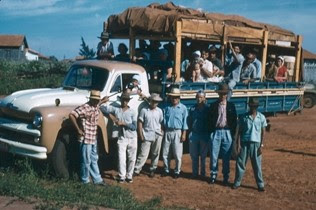 |
| New arrivals from Brazil's Northeast |
Getting Groceries
There were other things to get used to. The grocery stores were very basic and carried little more than canned and dry goods. Bread, like a miniature french bread (pão de água) came by delivery in the early morning. (Fresh bread with butter and sometimes jam - deelicious!) A man on a horse with saddle bags packed with milk-filled wine bottles brought us unpasteurized milk every day. And
sometimes one suspected that they were “baptizing” the milk with water. That milk had to be boiled before use, and sometimes we resorted to powdered milk which was also available.
 |
| Milk came in wine bottles, unpasteurized. |

Fresh fruits and vegetables were hard to get. Usually you could find carrots, potatoes and tomatoes, sometimes cabbage and little else at the little green grocer’s on main street. We ended up going to Paranavai once every week or two, so we could have luxuries like lettuce, fruit and whatever else we could find. The stores never had papaya. We learned early on that if we didn’t plant it ourselves, we would have to go out in the coffee fields along the roads, where there were always plenty of volunteer papaya trees. The green grocer, Jaime (who also ran the town’s print shop and became a great friend of ours) was the one who urged us to do that! Ah yes! All this we learned to do in those first few months.
Money Exchange
And we needed to have the local currency, but changing money was another matter. It was possible to use the local bank, but they couldn’t do it locally unless you had the cash. Cheques had to be sent away, and you were never sure when the exchange might happen so you could pick up your cruzeiros. So once in a while I had to take out a loan at the bank. As a result whenever I travelled to São Paulo which was not infrequent since I was on several mission committees, I bought enough cruzeiros to last for a month or two, sometimes more.
Air Travel
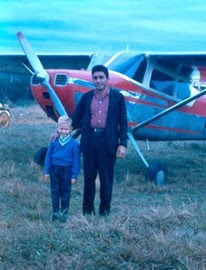
Air travel was inexpensive. The first years we were in Loanda, air travel from the interior was actually government supported, to help open the interior. So it was usually cheaper to travel by air than by Jeep. However, the government support soon ended as the political situation deteriorated after Janio Quadros who had been seen as the savior of Brasil when elected president, suddenly stepped down, but that’s another whole story. The good part is that flights were always available, either by a DC3 three times a week or by teco-tecos like the one in the photo. The airport was simple with only a small garage-like structure for arrivals and departures. When one of the teco-tecos arrived, they would fly over the taxi
line in town signaling the need for one of them to pick up the passengers.
Coffee
The interior was opening up because the soil was rich, the price of coffee was favourable and so every bit of land that was cleared was being planted with little coffee seedlings. The farms were small and the land company was fostering the arrival of farmers from northern Brazil to farm this new area. When we arrived, the first coffee bushes were beginning to produce and a huge coffee warehouse was being built not far from town.

Hopes Dashed!

Fires as in this photo, taken by Bob Kasperson, tore through the forests and coffee fields alike, bringing an end to the dreams of coffee farmers in northern Paraná
In 1963 we left for our first furlough which was for a full year. We hired our neighbour who had an air taxi service to fly us to Londrina where we could catch the airline to São Paulo and from there to Canada. The night before had been cold, in fact the temperature had dropped below freezing, and as we took off, Luiz, the pilot, pointed out the damage. Everywhere where coffee was planted, the bushes had turned black from the frost, vast tracts of them. In fact, much of the virgin forest had blackened as well. Little did we know then that this was the beginning of the end for coffee production, not only in the Loanda area, but across much of the northern part of the state of Paraná. When we returned
to Loanda years later, it was to vast areas of grazing land for beef cattle, plus cotton, sugar cane or rice plantations. There was hardly a coffee bush in sight.
Where To Live?
But we’re getting ahead of ourselves. Our little family settled into our new neighbourhood, excited at the new surroundings, new friends and hopes. With housing scarce, we started life in Loanda, living in an empty storefront while we built a house on an empty lot.

It was a happy day when we were able to occupy our new house. The architect called it “tipo Americano”, I could never figure out why. I had never seen one like it before, nor have I since in Canada or the States. We painted it chrome yellow and planted grass around it, the latter apparently a novelty which was soon copied by the neighbours.

The Family Grows
With the rapid growth in the area, the city never had enough water, and so we hired a boy to pump water to the upstairs tank from water that was either trucked in or that dribbled in from the city’s supply lines. Without many of the modern amenities of home, Elna was forced to hire help. She found an “empregada” to help with cleaning and the care of Paul, and our water boy’s mother came to help with laundry.
 |
| Paul with our two Brazilians, Mark and Karen. |
Our Mission in Loanda
We were told to take our time in starting services. It was important, we were told, to settle in, get to know people and be a part of the community. So it wasn’t until January of the next year that we finally took our initial steps. We had a Vacation
Bible School with the help of Bible students from John Abel’s early Bible School in
Londrina. As I recall, there were two, Israel from Londrina and Aurea from Cianorte. Of course Elna and I were involved as well. We used the two-room school at the bottom end of Loanda. (Loanda was built on a hill, with the new section at the top and the old section at the bottom). We took our Jeep around the community and announced the VBS using a portable PA system. We were flooded with children, about 60 of them by the end of the week. We had our own varied curriculum, with lots of handwork, recess with lots of games and in general an enthusiastic time.

Dance Hall Beginnings
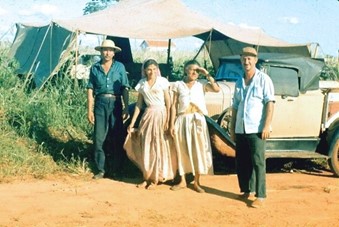
Then during Lent of that year we were offered the use of the town’s “Clube” for a week. Bob Kasperson came to preach, and Viola Reed played her accordion. Again, with the help of the Jeep and portable PA system we managed to fill the small hall. Many of the people came because of personal contact, but others we had never seen before. Among those who came was Manolo whom I had met when my tire was punctured on main street. Manolo ran the local tire shop and was only 50 yards or so from where it happened. He came the first night and as I greeted people at the door after the service he said something I marvel at to this day. To my complete surprise he said, “pastor, I’m ready to be converted.” As I recall, my rather unhelpful answer was “Manolo, I can’t convert anyone, only God can do that.” Manolo and his family became fast friends of ours and were one of several families who eventually were the foundation of our little mission congregation. Son Edson, who later became a pastor and eventually bishop of one of IECLB’s synods, later affirmed many years later that his father’s conversion dated back to those early days.
Storefront Chapel
 Our first accommodations for a meeting place are another interesting story. Again because of the constant arrival of new people to the community and lack of housing and commercial buildings, it was difficult to find a place to meet. When one of the pharmacies closed, I immediately inquired about who was the owner of the building, flew to Marilia in the state of São Paulo to see if I could rent the store and returned with the keys. We built pews, an altar and pulpit, put up a sign “Capela Luterana” and were soon having services. It was a good location. People came and we soon had an operating Sunday School at noon as was a common custom at the time, with services in the evening.
 Our Own Building

 |
| Arnaldo and Mercede’s Wedding |
We Reach Out
 |
| Santa Isabel |
During this time we hadn’t been idle in other places. One of those places was Santa Isabel, about 10 kilometres away. There we came in contact with a German Lutheran family who early on invited us to have services in their home. Irvin Kolm and his wife Edel owned a small grocery store with their home out back and that’s where we held the services. That also developed
into a small congregation, and when the mission decided to experiment with the placement of portable chapels, we opted in. The components were made in Loanda and trucked the few miles to their location. Then Pedro Olsen’s sons mounted it on a cement floor. There we were able to have services and Sunday School in the morning since we had none at that time in Loanda.
Reluctant Confirmand
Before we were to leave for furlough in 1963, I was determined to have my first confirmation class. This did in fact happen, and if I remember rightly 4 children of our group made their vows shortly before we were to leave for Canada. But one of the members was reluctant and didn’t join the group: Edson, Manolo’s son. When we returned a year later, I met Edson at our annual youth retreat and he excitedly told me that under Pastor Biel’s ministry, he had finally made his profession of faith at confirmation.
 |
| Edson as Student in Joinville |
We Exit, Biels Enter
 |
| Biels |


